
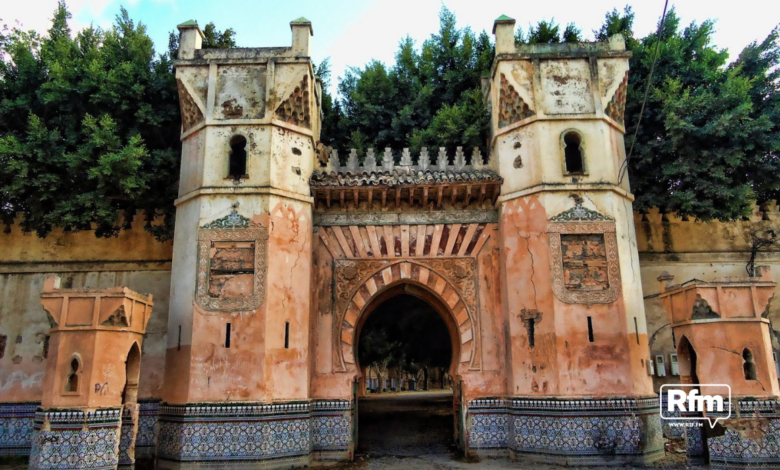
A historical landmark over a century old faces the risk of erasure amid an official silence that is sparking controversy, while civic voices demand the rescue of one of the Rif’s most prominent witnesses of collective memory.
May 2026 — Zeghenghane / Nador
In the heart of Zeghenghane, an old military barracks stands tall despite the cracks of time, carrying within its walls more than a hundred years of political and military transformations that have shaped the history of the Rif and Morocco. Yet today, this historical landmark faces a new threat no less dangerous than the wars it once witnessed: demolition.
The issue erupted after a widely circulated civic communiqué in digital and local circles in May 2025, warning of a plan to demolish the historic barracks — a move that triggered a wave of anger and indignation among civil society activists and those concerned with local heritage and history.
But what intensified the controversy was not only the talk of demolition, but the official silence surrounding the matter. To date, no clarifications or official positions have been issued by local authorities, elected officials, or political parties regarding the fate of this landmark, which many consider an integral part of the Rif’s collective memory.
From Colonial Landmark to Witness of Resistance
The barracks were built in 1912 by the Spanish colonial authorities, immediately after the suppression of the revolt of Cherif Mohamed Ameziane, one of the most prominent figures of the early resistance against Spanish colonial expansion in the Rif. It was then named “Regulares No. 5,” becoming one of the most important Spanish military bases in the region.
The historical irony, however, lies in the fact that the barracks itself later became a space associated with major resistance movements and transformations in the history of the region.
In 1912, the barracks were constructed following the suppression of Ameziane’s resistance. After the Battle of Annual in 1921, the area witnessed resistance operations led by the fighter Idris Khoja, who managed to temporarily liberate Zeghanghane from colonial control. In 1936, the barracks played a significant military role during the early stages of the Spanish Civil War.
After Moroccan independence in 1956, it was used as a base for elements of the Algerian National Liberation Front during their resistance against French colonialism, operating from Moroccan territory. And in 1973, a Moroccan military unit graduated from it and participated in the October War alongside Arab forces, contributing to battles for the liberation of the Syrian Quneitra.
These milestones, according to those familiar with the history of the Rif, make the barracks far more than an old military building — it is a material archive of collective memory encapsulating eras of colonialism, resistance, and liberation.
Official Silence Raises Questions
Observers of local affairs believe that the controversy surrounding the Zeghanghane barracks is not only about the possible demolition of a historic landmark, but also about the absence of any official clarification regarding the site’s future.
This comes at a time when civil demands continue to grow for a public debate about the fate of the barracks, considered one of the most significant historical testaments linked to the region’s twentieth-century history.
Heritage defenders point to numerous international examples where colonial landmarks were preserved and repurposed as cultural centers and museums, recognizing them as part of human and historical memory rather than mere architectural remnants.
“Silence is a crime akin to demolition, and history will record their names in this complicity — the collective conscience of future generations will not forgive them,” say some concerned citizens.
Despite the widespread discussion on social media, no official response has yet been issued to either confirm or deny the existence of an actual demolition project.
Is This About Erasing Memory?
Civil society activists argue that the issue goes beyond an old building, raising a deeper question about how the state and local institutions deal with the historical memory of the Rif.
The circulation of this file also brings back into focus the fact that the Zeghanghane barracks case is not an isolated incident, but part of a broader pattern seen across the Rif region in recent years — where demolition or neglect has affected a number of historic sites and landmarks in cities such as Nador, Al Hoceima, and Driouch. Critics speak of an absence of effective mechanisms for protecting local heritage, as numerous historical landmarks have disappeared before everyone’s eyes without any clear intervention to halt their erasure or restore them.
Heritage advocates stress that the natural choice should have been restoration and rehabilitation rather than demolition, especially since the barracks could be transformed into a cultural space or museum of memory and resistance — contributing to the region’s cultural and tourism development.
One civil society activist from the Nador province stated:
“When these landmarks are demolished, they cannot be replaced. The right thing is to restore them and integrate them into cultural projects that preserve the collective memory of the region.”
Many heritage and local activists also question why controversy over the demolition or marginalization of certain historical sites in the Rif repeatedly arises, while historical sites in major cities such as Rabat, Fez, and Marrakech continuously benefit from restoration, protection, and rehabilitation — even though some of those sites, according to observers, do not carry the same historical weight as certain Rifian landmarks.
They argue that the ongoing debate around the Zeghanghane barracks reflects broader demands for a balanced approach to protecting national heritage — one that encompasses all regions of Morocco without exception, while recognizing the historical and symbolic value of each landmark within both local and national collective memory.
Civil Society Demands
Those advocating for the preservation of the barracks call for an immediate and unconditional halt to any demolition or alteration affecting the site, along with a transparent public debate involving historians, experts, civil society actors, and local residents. They also call for the launch of a legal process to classify the barracks as a nationally protected historical monument, and for the development of a rehabilitation project to transform the site into a center of memory and a museum of resistance and liberation.
A True Test for Heritage Protection
The Zeghanghane barracks reveal the fragility of mechanisms for protecting historical heritage in Morocco, particularly in regions far from major urban centers. It also brings back to the fore a question long raised by those concerned with cultural affairs: who decides which memories deserve to be preserved, and which are left to oblivion?
For many in the Rif, this is not merely about an old military building — it is a matter of recognition of local history and the protection of collective memory from erasure. Pending any official clarification, the fate of the barracks remains suspended between the demands of preservation and the logic of demolition, as time continues to consume one of the last remaining material witnesses to a century of the Rif’s history.