Workers at the Chinese AEOLON factory in Nador complain of meager wages and chemical hazards
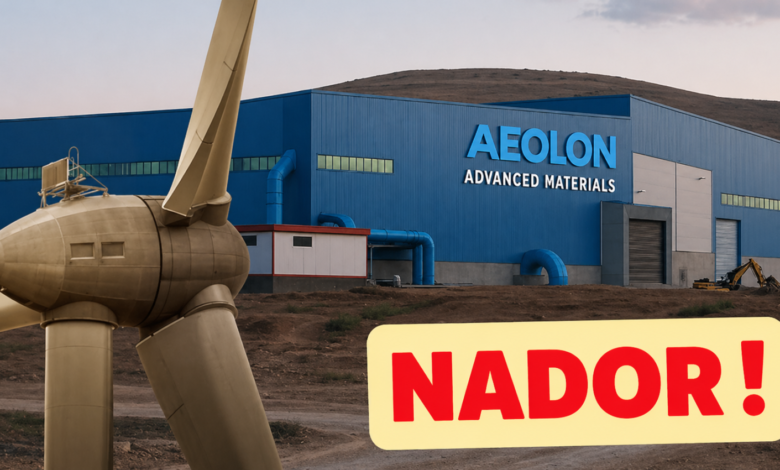
Nador — When AEOLON Renewable Energy Morocco announced that construction of its factory would begin in January 2024, the region received the news with cautious optimism. A €220 million investment, over 3,300 promised jobs, and a factory said to be the largest of its kind in Africa, the Middle East, and Europe. The official rhetoric was impressive. Yet the reality described by workers today is fundamentally different from that rosy image.
Over several weeks, our editorial team has been in contact with former and current workers at the factory located in the Betiwa Industrial Acceleration Zone, in the province of Nador. The picture that emerges from their testimonies reveals a consistent pattern of violations: wages insufficient to cover transportation costs, daily exposure to classified hazardous chemicals without adequate protective equipment, mandatory overtime without fair compensation, and suspicious official silence regarding serious health incidents whispered among workers.
A Company Built on Promises
AEOLON Technology is a Chinese company founded in 2007, specializing in the manufacture of wind turbine blades. The Nador factory is its first project outside of China. The investment project was approved under the new investment charter, and the inauguration ceremony was attended by the Minister of Investment, Karim Zidane, and the Governor of the Oriental region. The company attracted thousands of applicants through the National Agency for the Promotion of Employment and Competencies (ANAPEC).
However, behind this official facade lies a reality that remains largely disclosed. The factory’s core operations rely on epoxy resins, fiberglass, and styrene — chemicals classified by international studies as hazardous substances requiring strict occupational safety requirements.
Chemicals Without Protection: A Silent Danger
What makes the AEOLON case in Nador particularly concerning from a health perspective is the very nature of the production process. Wind turbine manufacturing relies heavily on composite materials made of epoxy resins, styrene, and fiberglass. International scientific studies agree that these materials pose a serious health risk if strict precautions are not taken.
Styrene, when it evaporates within enclosed or semi-enclosed manufacturing spaces, can reach concentrations far exceeding international safety limits. A scientific study published by the US National Institute for Occupational Safety and Health (NIOSH) recorded styrene concentrations in wind blade factories ranging from 66 to 150 parts per million — far exceeding the short-term exposure limit of 40 parts per million. Another study documented that exposure to epoxy resins can lead to allergic contact dermatitis in over 17% of exposed workers, in addition to respiratory and vision disorders.
In this context, the testimonies of AEOLON workers in Nador take on an even more alarming dimension. Workers we spoke with describe a lack of adequate protective equipment and a work environment filled with chemical fumes and poor ventilation. Their accounts frequently mention cases of cancer affecting young people who worked at the factory without receiving any compensation, casting a long shadow over the future of everyone employed at this facility.
In this context, the testimonies of Ayonon workers in Nador take on an even more alarming dimension. The workers we spoke with described a lack of adequate protective equipment and a work environment filled with chemical fumes and poor ventilation. They frequently mentioned cases of cancer among young people who worked at the factory and received no compensation, casting a long shadow over the future of everyone employed at the facility.
“You work with completely chemical materials, they give you 3400 dirhams, you don’t get paid until the 11th of the month. They make you work 11 extra days on top. They treat us like slaves, not like human beings. When there’s no work, they tell us: ‘Pick up the tape from the floor,’ or ‘Wipe the dust off the machines,'” says a former worker at the AEOLON factory, Nador.
3400 Dirhams: A salary that runs out before month’s end:
The workers at the factory earn a monthly salary of 3,400 dirhams. This figure, in the context of rising living costs in the Nador region and high cost of the daily commute from surrounding towns to the Betiwa industrial zone, seems almost tragic. Workers say that what they spend on work logistics — transport and meals — consumes most of the wage before the month is over, turning work into a draining cycle with no real return.
The situation is further complicated by what the workers describe as 11 mandatory overtime days per month, seemingly by force rather than choice, with no sense that the compensation is commensurate with the labor. In the absence of active and independent unions to protect their rights, workers find themselves with only one option: submit or leave.
Lack of Insurance: An Open Wound
One of the most pressing issues raised by the workers is the lack of effective or adequate health insurance. In a factory where workers handle hazardous chemicals daily, the absence of health coverage is not merely an administrative oversight, but a serious threat to their health. Workplace accidents reported by workers have gone uncompensated, and serious health conditions — including suspected cancer cases — have been left without institutional follow-up.
Under the Moroccan Labor Code, employers are required to register workers with the National Social Security Fund (CNSS) and provide a safe working environment according to applicable standards. This places the company’s conduct, as described by workers, in direct confrontation with the national legal framework.
The Human and Social Dimension
The expressed concerns extend beyond the immediate work environment. Several of our contacts spoke of a concerning social phenomenon: some Chinese supervisors are using personal relationships with local young women as a means to obtain residency and circumvent the requirement to leave the country every three months. This points to weaknesses in the oversight structure regarding the foreign presence in the region and its social repercussions.
Some workers also observe what they describe as racism within the production environment, where Moroccan talent is treated as cheap labor rather than a partner in a development project. This is a clear contradiction of the official discourse describing Chinese investment as “strategic cooperation” and an “equal partnership.”
What the law says and what happens on the ground
The Moroccan Labor Code is clear: the minimum wage for industrial workers must not fall below the legally established minimum, and overtime requires additional compensation of at least 25% above the regular wage. Occupational health and safety laws also require employers to provide protective equipment, first aid resources, and conduct regular assessments of occupational hazards.
In a factory handling hazardous chemicals such as epoxy, styrene, and composite fibers, occupational safety requirements become even more critical. This places responsibility on regional authorities and the regional labor inspectorate to verify the company’s compliance with these standards and subject it to effective oversight.
AEOLON from the official angle
Official documents and the company’s website present the Nador factory as a model of environmental and social responsibility: digital energy management, industrial waste treatment, and a modern work environment. The company has also stated in its recruitment documents that there is a position for an “Environmental, Health, Safety and Security Manager” responsible for overseeing occupational safety commitments for the project.
Our editorial team requested a response from the company regarding the information contained in this investigation, but received no reply by the time of publication.
Development for Whom?
The question raised by this investigation is not against foreign investment in Morocco, but rather about the quality, conditions, and standards of that investment. Renewable energy is not truly green if it is produced by the hands of young Moroccans breathing hazardous chemical fumes daily without adequate protection, for wages that barely cover a bus ticket.
The Nador region, whose residents have long complained of marginalization and isolation from decision-making centers, deserves investments that respect dignity of the worker over production figures. Regional authorities are urged, sooner rather than later, to subject this factory to rigorous professional inspection, verify workers’ conditions, and ensure their full legal rights, particularly regarding health and safety in the face of hazardous chemicals.
True development is not measured by the size of investment alone, but by the value it adds to people’s lives.
This report is based on testimonies from current and former employees, official investment documents, and accredited scientific studies on occupational health hazards in wind turbine manufacturing. The company did not respond to requests for comment.