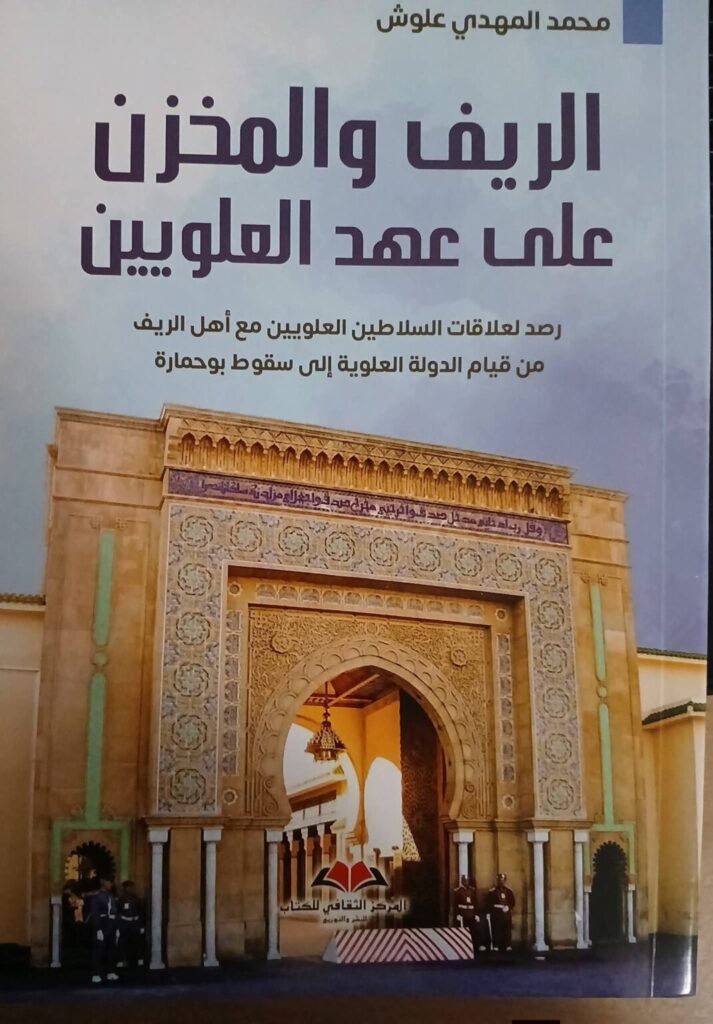

The book The Rif and the Makhzen in the Alawite Era: A Survey of Relations Between the Alawite Sultans and the People of the Rif, from the Founding of the Alawite State to the Fall of Bouhmara, by Mohammed al-Mahdi Allouch, offers a different reading of Moroccan history, re-examining the question of the Rif’s relationship to the building of the Alawite state from an angle that goes beyond the conventional academic narrative.
While the most widely circulated historical accounts have entrenched a vision centered on the Alawite movement originating in Tafilalt, with only a brief passage through other regions such as Taza, this work proposes an alternative perspective that highlights the Rif’s presence as a central actor in foundational moments of the state’s history. The book’s value, therefore, lies not only in retelling events, but in pushing the reader to reconsider certain long-held historical assumptions.
The author meticulously traces the trajectory of the relationship between the people of the Rif and the central authority from the mid-seventeenth century up to the imposition of the Protectorate in 1912, analyzing a number of junctures that shaped this relationship within its political and military context. What emerges is that the Rif was not merely a marginal presence in the history of the state, but rather a space that contributed — through local alliances and personalities — to sustaining the process of founding and expansion under the Alawite sultans.
The book draws on historical data indicating that Rifian tribes and figures played significant roles in supporting Moulay Rachid and then Moulay Ismail, whether in forming the early armies or in administering territories and functions within the Makhzen’s structure — evidence the author presents as proof of the depth of the Rif’s presence within the emerging state.
Yet this reading simultaneously opens a broader debate about the very manner in which history is written: are we witnessing a re-evaluation of regions that have long remained on the margins of the official narrative, or a reinterpretation of events from a single perspective that requires greater balance and comparison with other readings?
In any case, the book succeeds in raising a central question about the nature of the relationship between the Rif and the Makhzen: was it a relationship of integration and historical partnership, or a complex one in which alliances and tensions intertwined across different periods?
Ultimately, this work represents a significant contribution to the debate on modern Moroccan history — not as a definitive text, but as a contribution that opens the door to a more pluralistic and balanced reading of the Moroccan historical narrative.