The reality of publishing in Tamazight in Morocco raises growing questions about the volume of written cultural production and the extent to which it keeps pace with the transformations that the Amazigh language has witnessed in recent decades, especially after its recognition as an official language and the establishment of institutions dedicated to its development.
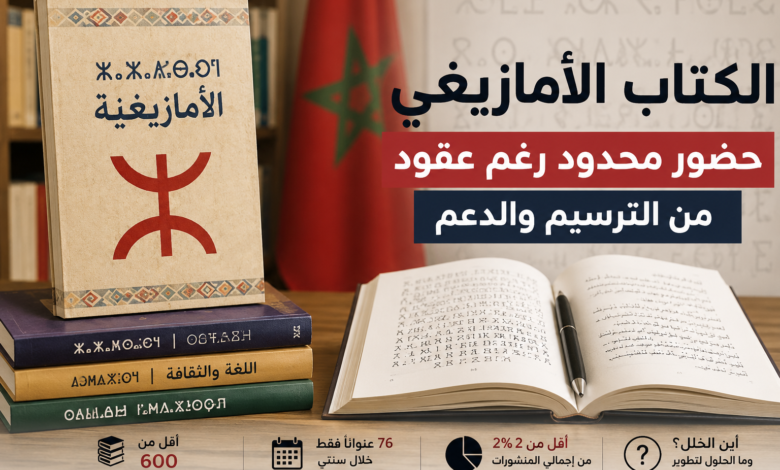
Available data on the publishing sector indicate that the number of books published in Tamazight remains limited compared to other languages spoken in Morocco. Over approximately twenty-five years of the Royal Institute of Amazigh Culture’s work, the number of titles published under its supervision or with its support has not exceeded around 600—a figure that many observers consider modest given the timeframe and available resources.
Conversely, some civil initiatives have achieved notable results with limited resources. Among these is the “Tira” Association in Agadir, founded in 2009, which has managed to publish nearly 300 titles across various fields, relying on self-driven efforts and diverse cultural partnerships.
Recent publishing figures reveal the persistence of this disparity. During 2024 and 2025, the total publications issued in Morocco, including books and periodicals, reached approximately 4,124 releases, while publications in Tamazight amounted to only 76 titles. Moreover, most of these releases fall within the realm of literary creativity, particularly poetry, novels, and short stories.
During the period between 2022 and 2023, the presence of Tamazight was even more limited, with only about 30 titles published, reflecting the ongoing challenges facing authorship and publishing in this language.
Arabic remains dominant in the national publishing market, accounting for more than 80% of total publications, followed by French with over 15%, then English at about 2.5%, while the share of Tamazight remains limited compared to its constitutional and cultural status.
This situation is also evident during the International Publishing and Book Fair, where the presence of Tamazight books is confined to a limited number of pavilions compared to other publishing houses and cultural institutions. The display of Tamazight publications is often restricted to a number of specialized bodies and cultural associations concerned with Amazigh language and culture.
This reality raises fundamental questions about the reasons for the weakness of written production in Tamazight, despite the institutional and legislative progress the language has witnessed. It also sparks debate about the role of official institutions, universities, cultural associations, and researchers in supporting authorship, translation, and publishing, thereby contributing to building a diverse knowledge base capable of meeting the needs of readers, researchers, and students.
Observers of cultural affairs believe that the future of Tamazight is not only tied to its presence in education and administration, but also to its ability to produce knowledge and expand the scope of publishing and authorship across various scientific, literary, and intellectual fields, thereby ensuring the enhancement of its status as a language of culture, creativity, and knowledge.