When Spain Celebrates Many Flags, Why Does the Amazigh Flag Still Spark Debate in Morocco?


What a World Cup celebration reveals about identity, symbols, and national confidence
Spain won the 2026 FIFA World Cup trophy. But the image that stayed with me wasn’t the trophy itself.
It was the medal ceremony.
Several Spanish players celebrated with the flags of their regions rather than the Spanish national flag. Gavi proudly held the Andalusian flag. Dani Olmo celebrated with Catalonia’s Senyera. Pedro Porro carried Extremadura’s flag. Borja Iglesias wrapped himself in Galicia’s. Pedri and Yeremy Pino both displayed the flag of the Canary Islands, despite coming from different islands within the archipelago. Álex Baena went even further, waving the municipal flag of his hometown, Roquetas de Mar.
The scene generated little national controversy. For most Spaniards, it was simply an expression of regional pride within a shared national celebration. No serious debate emerged about whether these players were undermining Spain’s unity or questioning their patriotism. Their regional identities and their Spanish identity were seen as perfectly capable of existing together.
That image raises an interesting question.
Why does celebrating local identity seem so natural in one country, while provoking suspicion in another?
The contradiction back home
Now a similar scene for Morocco.
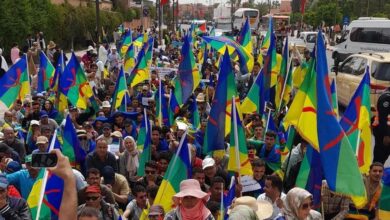
An Amazigh flag appeared in the stands during a Morocco national team match in the World Cup.
Within minutes, social media fills with familiar comments: “Morocco has only one flag. The red with green star!!”
The difference in reaction is striking.
The issue is rarely the piece of cloth itself. It is what people believe that symbol represents. Is cultural diversity a source of strength that enriches a nation? Or is it something that weakens national unity?
Those two questions lie at the heart of the debate.
The Amazigh flag isn’t competing with Morocco
One of the biggest misconceptions surrounding the Amazigh flag is the assumption that it somehow competes with the Moroccan national flag.
For most of those who carry it, that has never been the point.
The Amazigh flag represents an indigenous civilization that has existed across North Africa for thousands of years. Amazigh communities inhabited the region long before the arrival of Arabs in the seventh century and long before the creation of modern nation-states. The flag is not intended to replace Morocco’s national symbol but to express a cultural and historical identity that forms one of the country’s oldest foundations.
To many Amazigh people, carrying the flag is simply another way of saying:
“This is my culture & identity & part of who I am.”
That statement does not necessarily conflict with any type of loyalty to Morocco.
In contrast, raising the Amazigh flag in Morocco—and even in Algeria—still makes some people uneasy and is sometimes portrayed as a threat to national unity. Yet for many, it is simply a cultural and civilizational symbol representing an ancient identity deeply rooted in the history of North Africa.
In my view, the problem is not the flag itself, but the way diversity is understood. A country that is confident in its identity should not fear the recognition of its historical and cultural root. Diversity does not weaken a nation; it gives it greater depth and strength.
Confidence doesn’t fear diversity
What impressed me most about Spain was not the number of regional flags.
It was the confidence behind them.
Spain is hardly a country without political tensions. Catalonia’s independence movement remains one of Europe’s most prominent separatist disputes, and the Basque Country has its own complex political history. Yet the presence of regional flags during one of Spain’s greatest sporting triumphs did not automatically trigger accusations of disloyalty.
The celebration suggested something important: expressing attachment to one’s region is not automatically viewed as rejecting the nation.
That distinction matters.
National identity does not have to erase local identity in order to survive.
Morocco’s unfinished draft
Morocco officially recognized Amazigh as an official language in the 2011 Constitution. Tamazight is taught in schools, used in public institutions, and broadcast on state television.
Yet the Amazigh flag still generates controversy whenever it appears in public spaces, particularly during sporting events.
That contradiction deserves reflection.
If Amazigh identity is officially recognized as part of Morocco’s national identity, why does one of its most recognizable cultural symbols continue to provoke discomfort among some segments of society?
Perhaps the debate is less about the flag than about how Morocco continues to negotiate its own understanding of identity.
A fair counterargument
It is important to acknowledge that those who criticize the display of the Amazigh flag are not necessarily acting in bad faith.
Many countries have experienced separatist movements, including Spain itself. Catalonia’s contested 2017 independence referendum demonstrated how cultural symbols can sometimes become intertwined with political movements. Some therefore argue that distinguishing between cultural expression and political symbolism is not always straightforward.
Others point out that the Amazigh flag is not equivalent to the flag of a Spanish municipality or autonomous community. Unlike those official territorial flags, the Amazigh flag represents a broader cultural movement that extends across several North African countries. From that perspective, the comparison is not entirely identical.
These arguments deserve consideration.
But they should not end the conversation.
Beyond one flag
The real question is not whether Morocco has one national flag.
It does.
The more important question is whether a nation can be confident enough to embrace every layer of its own history without viewing cultural identity as a threat to national unity.
Spain’s World Cup celebration offered a reminder that national identity does not have to be built on uniformity. A person can celebrate being Andalusian, Catalan, Galician, Canarian—or Spanish—all at once.
Morocco, like every diverse nation, faces its own historical and political realities. Yet acknowledging Amazigh identity does not diminish Moroccan identity. For many citizens, it is one of the identities from which Morocco itself was built.
Perhaps the debate is not really about flags.
Perhaps it is about whether we see diversity as something to fear—or something strong nations are confident enough to embrace.
it’s really weird…