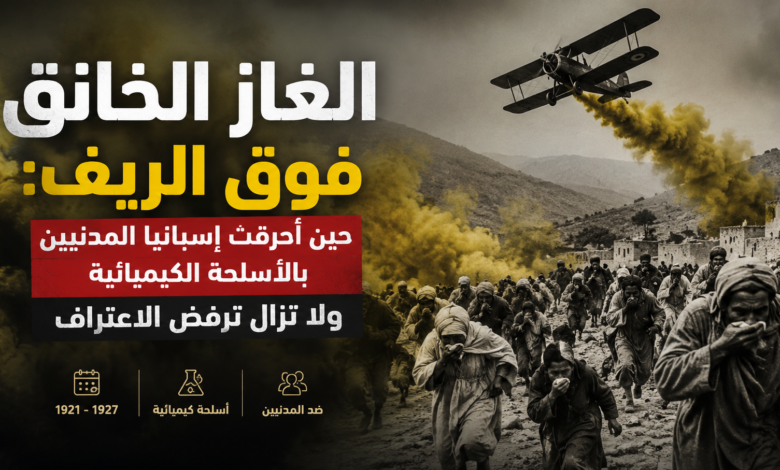
Between 1921 and 1927, Spanish forces turned the skies over Morocco’s Rif region into a chemical hell, raining lethal poisonous gases down on villages, markets, and rivers — a fact proven by researchers and confirmed by historians, but which Madrid still refuses to officially acknowledge it to this day.
Historical Investigation · The Rif, Morocco · 1921–1927 · May 2026
In 1924, over the mountains of Morocco’s Rif region, Spanish pilot Hidalgo de Cisneros dropped the first hundred-kilogram mustard gas bomb from his warplane, detonating it over land inhabited by civilians, not combatants. This was no isolated incident — it was one link in a chain of systematic chemical crimes waged by Spain against the people of the Rif, crimes for which it has continued to evade accountability a century later.
| 1921: First use of chemical weapons | 1,680 bombs dropped daily | 127 fighter and bomber aircraft | 13,000 Spanish soldiers killed at Annual |
|---|
From the Disaster of Annual to Revenge by Gas
To understand what happened over the Rif, one must return to July 1921, when the Spanish army collapsed at the Battle of Annual before the fighters of Abd el-Krim al-Khattabi, leaving at least 13,000 dead according to official Spanish figures — which Spanish politician Indalecio Prieto described in parliament as: “We are in the most acute period of Spanish decline, and the African campaign is a complete and absolute failure that cannot be mitigated.”
British historian Sebastian Balfour of the London School of Economics argues in his book Deadly Embrace that the primary motivation behind the chemical attacks was outright revenge for the defeat at Annual, not military necessity. The Spanish army deliberately targeted the most densely populated areas, including public markets and rivers, to inflict maximum human and psychological devastation on the civilian population.
The Chemical Agents Used in the Rif
Mustard Gas (Yperite) — The most widely used and lethal agent, causing severe burns to the skin and respiratory system; first dropped from the air in 1924.
Phosgene — A highly toxic asphyxiating gas that attacks the respiratory system and causes rapid death when inhaled.
Diphosgene — A more dangerous variant of phosgene, forming a lethal combination when used alongside other gases.
Chloropicrin — Both a tear agent and an asphyxiating agent simultaneously, used to force victims to remove their gas masks.
Germany in the Shadows: Hidden Involvement After World War I
Complicating matters further is Germany’s role in supplying Spain with these weapons. In August 1921, Madrid rushed to negotiate with Germany for supplies of mustard gas through a specific intermediary — chemist Hugo Stoltzenberg, a figure linked to Germany’s secret chemical weapons programs in the early 1920s. Most brazenly, this cooperation was carried out in open violation of the Treaty of Versailles of 1919, which prohibited Germany from manufacturing such weapons. The first shipment arrived at the port of Melilla in 1923 and was later loaded onto Farman Goliath military aircraft.
These materials were produced at the Fábrica Nacional de Productos Químicos near Madrid, a facility established with extensive German assistance. Spain ultimately granted Stoltzenberg Spanish citizenship as one form of reward for his contributions.
“I have been stubborn in my refusal to use asphyxiating gases against these natives, but after what they have done and after their treacherous and cowardly behavior, I will use them with genuine joy.” — Dámaso Berenguer, Spain’s High Commissioner in Morocco, in a telegram to the Spanish Minister of War, August 1921
Proving the Crime: Who Exposed It, and When?
This crime remained buried for decades, as Spanish authorities worked to conceal its facts and suppress information. But the truth gradually forced its way out through the accumulated efforts of researchers of various nationalities:
1974 — Spanish author Pedro Tonda Bueno published memoirs containing testimonies about the aerial dropping of toxic gases over Rif territory.
1990 — German journalists and researchers Rudibert Kunz and Rolf-Dieter Müller scientifically established the occurrence of the chemical attacks in their thoroughly documented book.
Later — British historian Sebastian Balfour of the London School of Economics, drawing on Spanish, French, and British archives, confirmed the large-scale use of chemical weapons against populated areas.
2007 — Spain’s Esquerra Republicana de Catalunya party introduced a bill in the Spanish parliament calling for official recognition — rejected by votes of both the Socialist and People’s parties.
A Historic First: The World’s First Aerial Mustard Gas Attack
These attacks hold a shameful distinction in military history: they represent the first time mustard gas was ever dropped from warplanes, in 1924 — a full year before the Geneva Protocol of 1925, which prohibits the use of chemical and biological weapons in warfare. In this sense, the people of Morocco’s Rif were the first civilian victims of an aerial chemical weapons bombardment in human history.
The Burning Legacy: Cancer and Institutional Silence
The Association for the Defense of Victims of the Rif War contends that the health consequences of these attacks continue to cast their shadow over the region’s inhabitants today, pointing to cancer rates recorded in Rif areas. While scientific research has not yet conclusively established a direct causal link between those chemical attacks and current health conditions, the question remains open and legitimate in the absence of any serious, independently funded scientific research into the matter.
Spain, meanwhile, continues to avoid official acknowledgment of this historical crime. When the Catalan Republican Left submitted its 2007 bill calling for such recognition, both the ruling Socialist Party and the opposition People’s Party voted against it — confirming that history in Spain remains hostage to political calculation.
Questions That Remain Unanswered a Century On
- Will Spain ever officially acknowledge its use of chemical weapons against civilians in the Rif?
- Does Germany bear a share of moral responsibility for its involvement in supplying these weapons in violation of international law?
- Why has no independent scientific study yet been funded to examine the link between historical chemical contamination and disease rates in the Rif?
- When will the collective memory of the Rif’s people — who paid for their resistance with their lives, their health, and their history — finally be honored?